Every health system says patient access is a priority. We wanted to know what it actually feels like to be an Oregon patient picking up the phone. So this month we called the published phone lines of 25 Oregon health systems, hospitals, FQHCs and physician groups, 634 calls to 575 distinct clinic lines, once in the mid morning and again in the early afternoon. No special numbers, no back channels. We dialed what a patient would dial, and we timed how long it took to hear a live human voice.
The short version
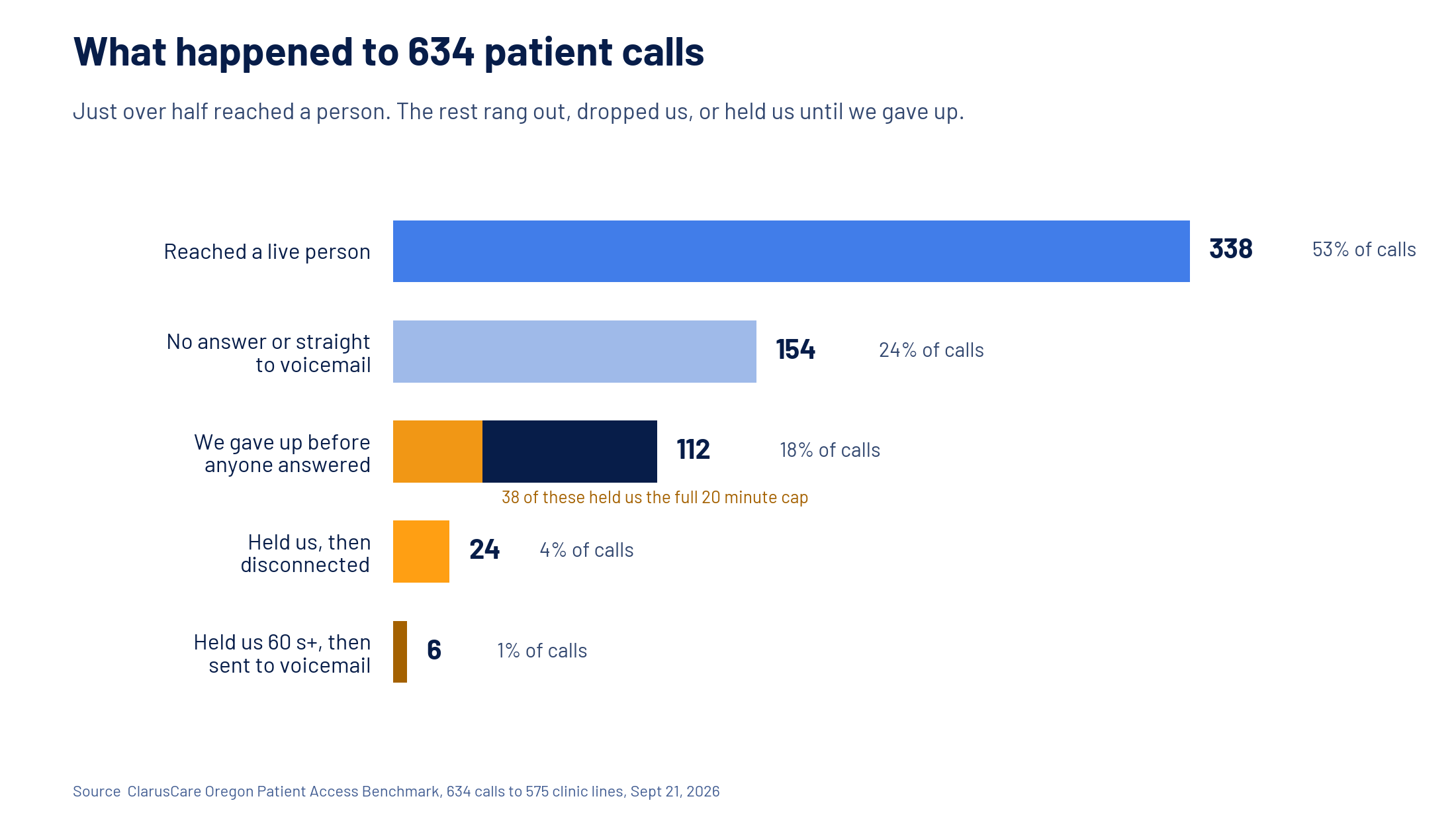
53 percent of calls reached a person. 338 of 634. The rest rang out, went to voicemail, dropped us off hold, or kept us waiting until we gave up (20 minute cap).
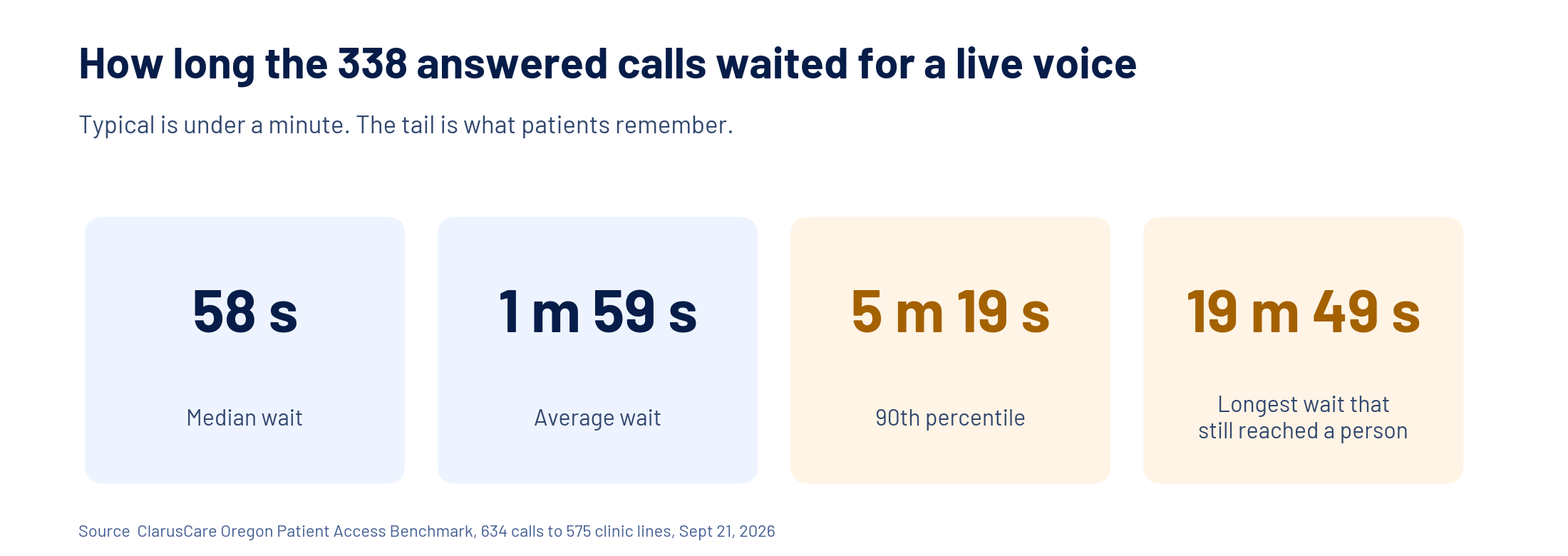
When someone did answer, the typical wait was just under a minute. Median 58 seconds. But the average was 2 minutes because the tail is long. 1 in 4 answered calls waited more than 2 minutes, 1 in 10 waited more than 5 minutes, and 13 calls waited more than 10 minutes before anyone picked up. The longest wait that still reached a human was 19 minutes 49 seconds.
112 calls never reached anyone before our 20 minute cap. On 38 of those lines we sat in a queue for the full 20 minutes and hung up without ever hearing a person. A patient would have given up long before that.
24 lines put us on hold and then disconnected. Six more held us for a minute or longer and then announced nobody was available and asked us to leave a message. Four of those six held us for roughly 15 minutes first.
Same clinic, same day, different experience. Of 64 lines we dialed in both windows, several answered in seconds in the morning and went unanswered or dropped us in the afternoon. Access is not a property of the clinic. It is a property of the hour.
What we measured
How the wait breaks down
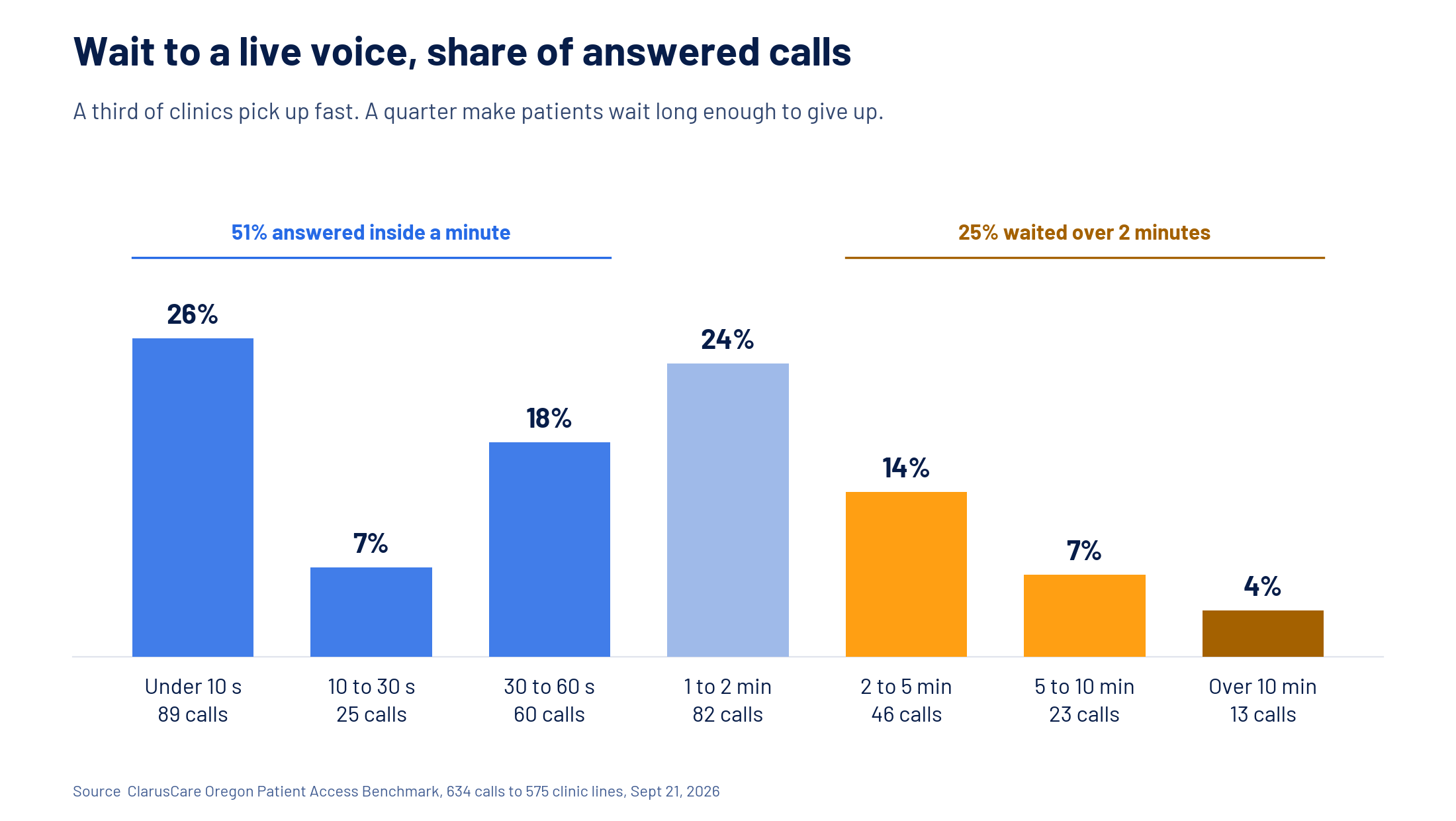
Roughly a third of clinics pick up fast. Roughly a quarter make patients wait between one and two minutes, which is long enough to feel it. The remaining quarter is where patients call back later, call a different clinic, or show up in the ED.
The two patterns that surprised us
Fast pickup and endless hold live in the same organization. One large system had one of the fastest median waits in the state, under 7 seconds, and also accounted for 30 of the 38 lines that held us for the full 20 minutes. A front desk that answers instantly and a specialty line that never answers are both that system's patient experience. Averages hide this. Line by line data does not.
Time of day changes the answer. The same line at the same clinic answered in 10 seconds mid morning and 77 seconds in the early afternoon. Another answered in 1 second in the morning and dropped us off hold after lunch. If your staffing model assumes a flat call curve, the afternoon is where patients fall through.
Why this matters for Oregon
Oregon's rural and community providers are staffing front desks in one of the tightest labor markets in the country, while call volume climbs. Starting January 2027, Medicaid work requirements and semiannual redeterminations will roughly double the outreach and inbound eligibility traffic those same desks have to absorb. A phone line that holds patients for 5 minutes today will not get better on its own next year.
Every unanswered call has a downstream cost. A patient who cannot reach the front desk to schedule does not get scheduled. A refill request that goes to voicemail becomes a second call and a third. A referral that cannot get through leaks to the competitor whose line picked up.
About the data
Calls were placed by Clarus Care on Monday, September 21, 2026, in two windows, mid morning and early afternoon Pacific time, to published clinic phone numbers.
Wait is measured from call start to the first word spoken by a live person, taken from the call transcript. It is not the carrier's connect time, which understates real waits by roughly a minute.
Calls we abandoned before anyone answered are excluded from the answer rate rather than counted against the clinic
Most lines received one call per window.
We did not speak with any staff and no recordings are published.
Where each Oregon system lands
We scored all 25 organizations on a single Patient Access Index built from three things a patient actually feels. Whether the call reached a person at all, how long it took, and how often the line held them five minutes or more, dropped them, or sent them to voicemail after a wait. Zero is the statewide average. Above zero is better than the Oregon field, below zero is worse.
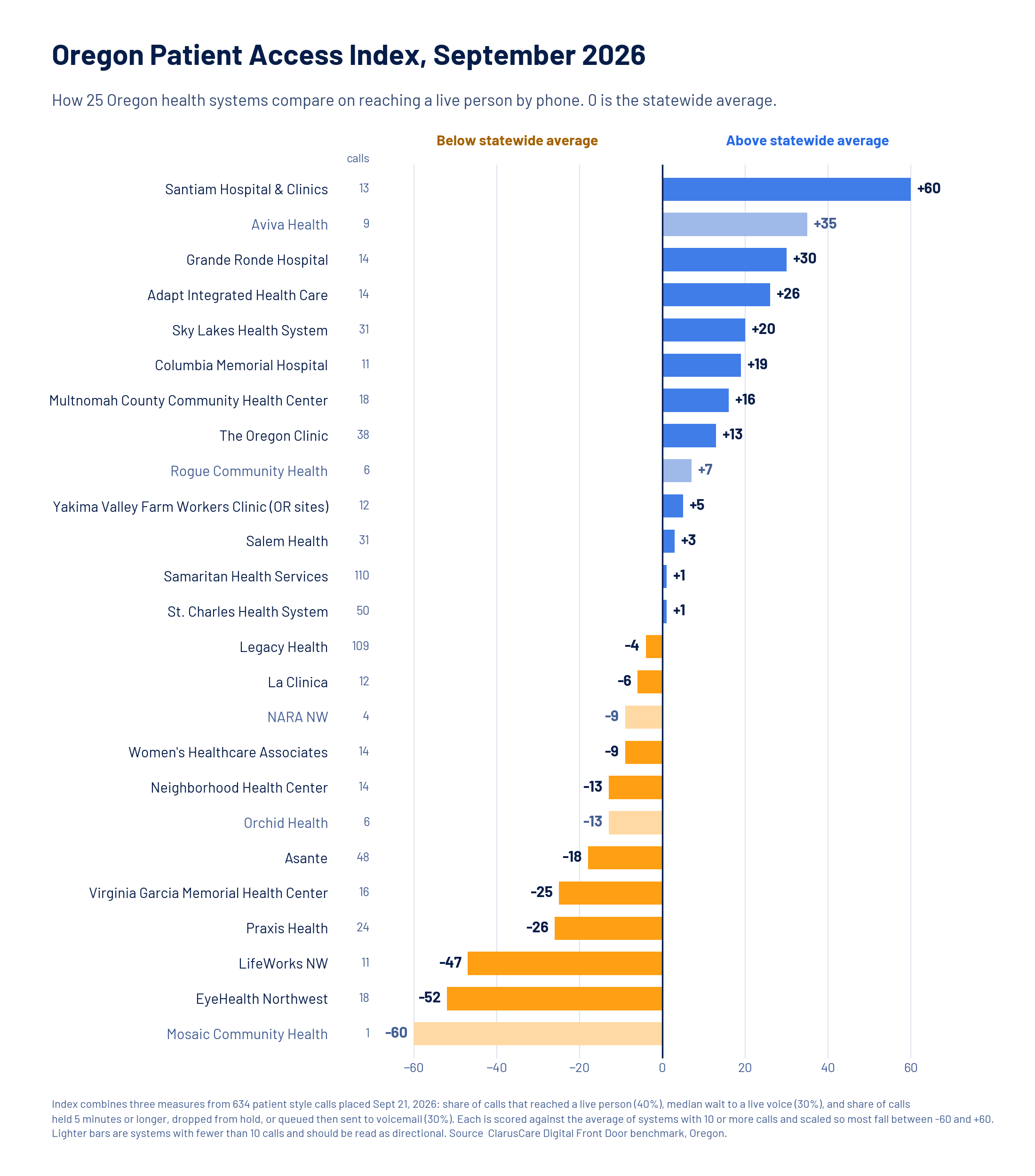
The spread is wider than most leaders expect. The top system answered nearly every call in under a second. The bottom three reached a person on fewer than one call in four. And two of the largest systems in the state sit right at average, which usually means half their clinics are carrying the other half.
The full report breaks every system down line by line, with answer rate, median and longest wait, how many lines held callers with no answer, and how each organization compares to the peers its patients also call.
Get the full report
The full Oregon report includes the line level data and a per organization table showing answer rate, median wait, longest wait and how many lines held callers with no answer, for all 25 organizations we called. It is the same view we walk through with health system leaders.
Download it below, or if you will be at the Oregon Rural Health Conference in Bend on October 7, come find us and we will pull up your system's numbers together.
Clarus Care helps health systems answer every patient call, day and night, with AI powered patient communication that routes, resolves and documents without adding front desk headcount.